
Time-sensitive notice: The C.L.I.C.K.D. scheme launched on 21 July 2026 and is currently running a pilot phase capped at 1,000 laptops, being released state by state. This is not a permanent, unlimited window – but the good thing is CREDICORP has not announced when the pilot closes or when the next phase opens. If you qualify, applying early matters more than usual right now.
If you have searched “credicorp.ng/clickd” in the last few days, you are not alone.
This is one of the fastest-moving consumer credit stories to come out of Abuja in 2026, and it genuinely matters for anyone trying to break into remote work, freelancing, or a tech career in Nigeria without four or five hundred thousand naira sitting idle for a laptop.
This guide walks through exactly what C.L.I.C.K.D. is, who can realistically apply today, how to fill out the form without getting rejected on a technicality, and – just as importantly – what CREDICORP still has not told the public.
We will update this page as new details come out, so if you are reading this weeks after launch, check the “confirmed versus unknown” table below first, since that is the section most likely to have changed.
What Is the C.L.I.C.K.D. Scheme, Really?
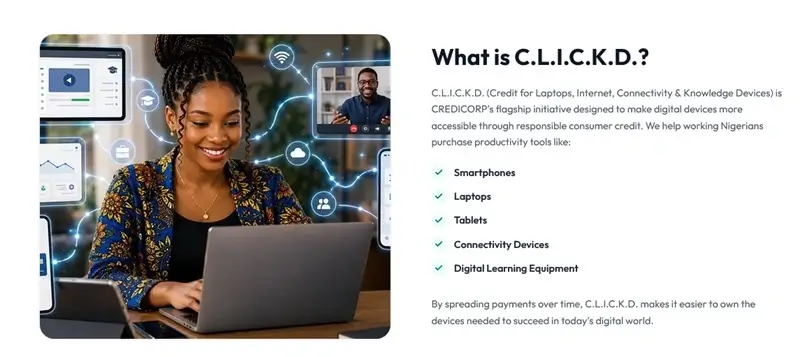
C.L.I.C.K.D. stands for Credit for Laptops, Internet, Connectivity and Knowledge Digital Devices.
It is a consumer credit initiative run by CREDICORP – the Nigerian Consumer Credit Corporation – in partnership with the Federal Ministry of Communications, Innovation and Digital Economy.
The scheme was unveiled on 21 July 2026 at the Afreximbank African Trade Centre in Abuja, with the Minister, Dr Bosun Tijani, serving as chief launcher alongside CREDICORP’s Managing Director and CEO, Engr. Uzoma Nwagba.
Strip away the acronym and the idea is simple: instead of asking someone to raise the full cost of a laptop or smartphone before they can start earning, learning, or working online, CREDICORP fronts the device through a structured credit arrangement, and the beneficiary pays it off over time.
Let’s put it this way. It is the same basic logic behind asset financing models that have worked well for phones and solar kits in parts of East Africa, adapted for Nigeria’s digital skills push.
But what’s the difference here? What makes this different from a normal loan product is who it is attached to.
The scheme’s first phase is deliberately tied to the Federal Government’s Three Million Technical Talent Programme, known as 3MTT, which trains Nigerians in tech-adjacent skills.
CREDICORP’s own framing is that a training certificate is not much use to someone who cannot afford the laptop needed to actually apply what they learned, and so C.L.I.C.K.D. exists to close that specific gap.
C.L.I.C.K.D. Batches
The pilot batch covers 1,000 locally assembled laptops. Seventy-seven beneficiaries had already received their devices in Abuja by the time of the launch event, and CREDICORP says the remaining units will roll out to qualified 3MTT fellows in other states in phases.
The initiative has also said the programme is designed to grow into an open, multi-partner scheme, inviting more banks, device manufacturers, and technology vendors to join over time, so the current shape of the programme is very much a starting point, not the finished product.
Who Is Actually Eligible for CLICKD Right Now?
This is the part most other write-ups gloss over, and it is where a lot of confusion is coming from.
The application form is open to any Nigerian across the 36 states and the FCT, but “the form is open” and “you will be approved” are two different things. It helps to think about eligibility in three tiers. Let me break it down.
If You’re a 3MTT Fellow
You are the primary target of this pilot. CREDICORP has publicly and repeatedly confirmed that the current 1,000-laptop batch is being distributed to 3MTT fellows, delivered through the Learn2Earn platform. If you are enrolled in or have completed the 3MTT programme, you have the clearest path to actually receiving a device from this first round, and your training records will likely be cross-checked against the 3MTT database during assessment.
Category 1: If You’re Not in 3MTT But in Another Digital Talent Programme
The application form also lists several other talent programmes as options: Andela Learning Community, Learn2Earn, ALX Africa, HNG Internship, AltSchool Africa, and Genesys Tech Hub.
CREDICORP has not publicly confirmed that fellows from these programmes are receiving devices in the current 1,000-unit batch; only 3MTT has been named so far.
That said, their presence on the form strongly suggests they are being lined up for a near-term expansion rather than included as a formality. So, if you fall into one of these programmes, it is still worth applying now so your interest is on record, but set your expectations around a later phase rather than an immediate laptop.
Category: If You Don’t Belong to Any Talent Programme Yet
The form does not require you to be in a talent programme to apply to; employment categories on the form include salaried workers, freelancers, business owners, students, job seekers, and NYSC members, with no explicit talent-programme requirement stated for those categories.
In practice, though, the pilot’s device allocation has clearly prioritised 3MTT fellows, so a freelancer or small business owner with no talent-programme affiliation is applying into a queue with far less visibility on timing.
Therefore, if this describes you, apply anyway since it costs nothing, but also read the “what to do while you wait” section further down, because there are faster routes to a device in the meantime.
Summarized requirements to apply for the FG’s laptops, smartphones, and others
- Names
- Active Phone Numbers
- Active email addresses
- State of residence
- Skill Niche/Area of interests
- Income range
- Active Digital Learning platform
- Device you are applying for
- Reason for device application
Let’s see how to apply for FG’s loan for laptops, smartphones, and others.
How to Apply for the CLICKD Device Loan (Step-by-Step)
The application itself is short. CREDICORP designed it to take a few minutes, but the sequence matters, and skipping details or rushing the income and programme fields is one of the more common reasons applications stalls. Here is the process in order.
1. Go to the official portal.
Type credicorp.ng/clickd directly into your browser rather than clicking a link from social media or a forwarded message. Given how much attention this scheme is getting, cloned or lookalike sites are a real risk, and the safest habit is to type the address yourself every time.
Copy this line “credicorp.ng/clickd” m> paste on your phone browser > enter > access the official site.

2. Click “I’m Interested.”
This is the button on the CLICKD landing page that takes you into the actual application form. There is no separate login or account creation step before this.

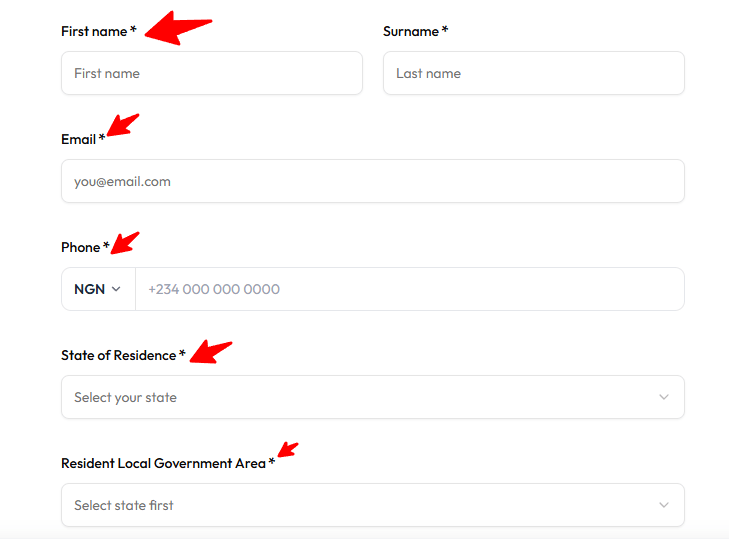
3. Select your persona – name, phone number, email, state of residence.
You can choose from any of the 36 states or the Federal Capital Territory. There is no indication that any particular state is prioritized over others in the pilot, other than that Abuja went first as the launch location.
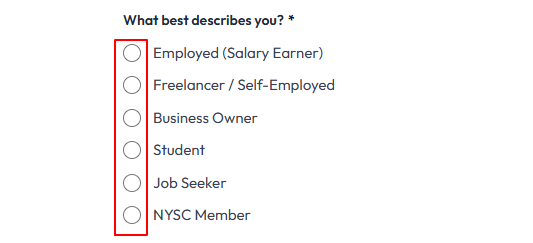
4. Choose your employment category.
Your options are salary earner, freelancer or self-employed, business owner, student, job seeker, or NYSC member.
Pick the one that most accurately describes your current situation – this field feeds into how your application is assessed, so there is no advantage to guessing which category “sounds better.”
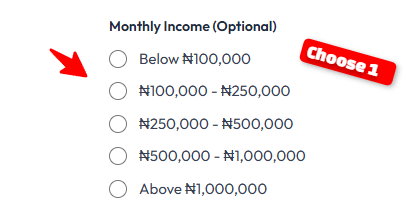
5. Enter your monthly income, if you have one.
This field is marked optional, and the bands run from below ₦100,000 to above ₦1,000,000.
Tips: It is tempting to skip it since it is optional, but leaving it blank gives CREDICORP less to work with when assessing what you can realistically repay, so filling it in honestly is generally the better move if you have a steady income to report.
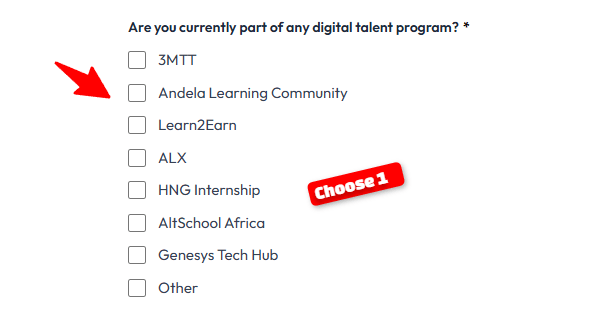
6. Indicate your digital talent programme, if any.
This is where you select 3MTT, Andela Learning Community, Learn2Earn, ALX Africa, HNG Internship, AltSchool Africa, Genesys Tech Hub, or none of the above.
Be accurate here since CREDICORP has indicated that programme claims are checked against partner databases, and a false claim is grounds for disqualification.
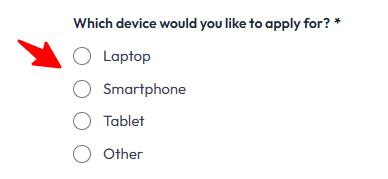
7. Select the device you need.
Your choices are laptop, smartphone, tablet, or another connectivity device. Choose based on genuine need rather than what you’d like to own – the form later asks why you need it, and a mismatch between the device requested and stated purpose is one of the quieter reasons applications get flagged.
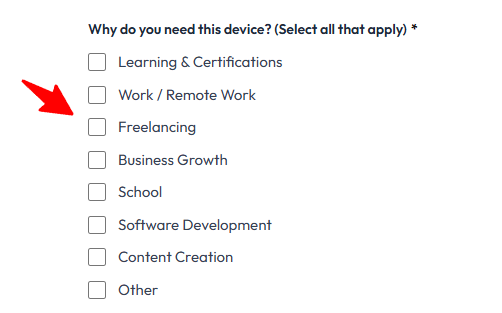
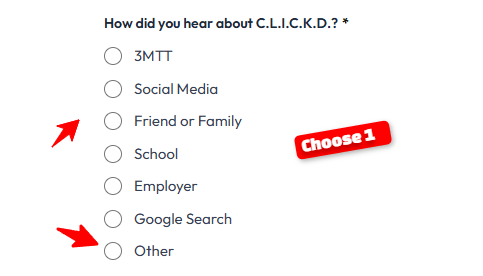
8. State why you need the device and how you heard about CLICKD.
Typical reasons include learning or upskilling, remote work, freelancing, or growing a business.
The “how did you hear about us” field usually includes options such as 3MTT, social media, referral, employer, school, or Google search – pick whichever is genuinely accurate.
9. Confirm and consent.
Before you can submit, you must tick three boxes: that the information you have given is accurate, that you agree to be contacted about your application, and that you consent to CREDICORP and its partners using your data to assess your eligibility.
Read these rather than clicking through blindly, since they are the legal basis for CREDICORP contacting you later.
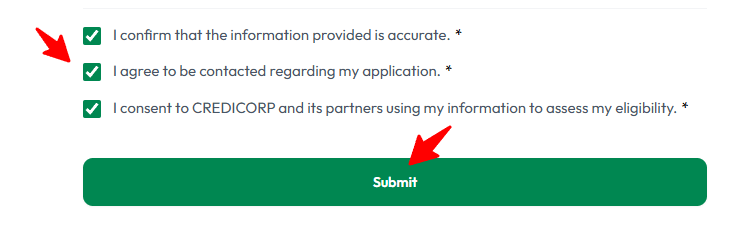
10. Submit and wait.
Once submitted, your application enters CREDICORP’s processing queue. This step is worth being clear-eyed about: submitting the form is an expression of interest, not an approval.
CREDICORP and its credit administration partner, Fidelity Bank, review applications and reach out to those who are selected; there is currently no published timeline for how long that review takes.
What CREDICORP Has Confirmed vs What’s Still Unknown
A fair amount of the noise around this scheme comes from people assuming details that simply have not been announced yet. Here is the state of play as of late July 2026.
| Detail | Status |
|---|---|
| Scheme name, purpose, and launch date | ConfirmedLaunched 21 July 2026 in Abuja |
| Lead agency and government partner | ConfirmedCREDICORP with the Federal Ministry of Communications, Innovation and Digital Economy |
| Launch partner | Confirmed3MTT, via the Learn2Earn platform |
| Pilot size | Confirmed1,000 locally assembled laptops |
| Beneficiaries so far | Confirmed77 in Abuja at launch, remainder rolling out by state |
| Credit administration partner | ConfirmedFidelity Bank |
| Device manufacturers | ConfirmedNASENI and Imose Technologies |
| Interest rate | PendingNot yet announced |
| Repayment period | PendingNot yet announced |
| Down payment requirement | PendingNot yet announced |
| Application deadline | OpenNone announced — portal remains open |
| Eligibility for non-3MTT talent programmes | PendingListed on form but not yet confirmed active in this batch |
Anyone quoting you a specific interest rate or monthly repayment figure right now is not working from official information, because CREDICORP itself has said those figures will be communicated to successful applicants individually, likely based on each person’s credit assessment.
Kindly treat confident-sounding numbers circulating on social media with real skepticism until CREDICORP publishes something official.
The Devices You Can Actually Get
For this pilot phase, the hardware on offer is locally assembled laptops, produced by NASENI (the National Agency for Science and Engineering Infrastructure) and Imose Technologies.
I think this is a deliberate choice rather than an afterthought – CREDICORP has framed the local-assembly angle as being about more than just getting Nigerians online; it is also meant to give domestic device manufacturing a genuine customer base instead of leaving it to compete purely on price against imported hardware.
The application form does ask whether you want a laptop, smartphone, tablet, or other connectivity device, which signals that the programme is designed to expand beyond laptops.
But as things stand today, the actual devices being handed out under the pilot are the locally assembled laptops. If you select a different device category on the form, you are registering interest for a future phase rather than the current batch.
Who’s Behind the Money: Fidelity Bank, NASENI and Imose Technologies
It helps to understand the mechanics here, because “government scheme” can make people assume this is a straightforward giveaway, and it is not.
CREDICORP is the coordinating body and the public face of the programme, but the credit itself is administered through Fidelity Bank, which handles the underwriting and repayment structuring for this first phase.
That detail matters because it tells you this is a genuine credit product with real repayment obligations, not a grant. Successful applicants are taking on a debt, even if a manageable one, and are expected to repay it.
On the hardware side, NASENI and Imose Technologies are supplying the actual laptops. NASENI is a long-standing federal agency focused on science and engineering infrastructure, while Imose Technologies is a Nigerian device assembler.
Having two manufacturers in the mix from the start also suggests CREDICORP is building in some supply redundancy rather than depending on a single assembly line to hit the 1,000-unit target.
How CLICKD Compares to Other Device Financing Options in Nigeria
If you don’t currently qualify for the pilot, or you’d rather not wait for a later phase, it’s worth knowing what else exists in the Nigerian market for financing a laptop or smartphone, and how CLICKD stacks up against those options on the details that actually matter.
The honest takeaway is that C.L.I.C.K.D. currently offers the least pricing transparency of the options above, simply because it is brand new and the terms have not been published.
What it offers instead is a genuinely low, and possibly zero, barrier to entry for people in the 3MTT ecosystem who would otherwise struggle to qualify for a private lender’s income requirements.
If you need a device immediately and cannot wait for CLICKD’s next phase, a retailer instalment plan or a cooperative scheme, where available, will at least tell you about the exact numbers before you commit.
Common Mistakes That Get Applications Rejected
A few patterns are already showing up in how people are misusing or mishandling this form, and they are worth flagging plainly rather than dancing around.
1. False Claim
Claiming a talent programme you are not actually enrolled in is the single biggest risk.
CREDICORP has indicated that programme affiliation is checked against partner databases such as 3MTT’s own records, and a false claim is grounds for outright disqualification rather than just a delay.
2. Wrong Device Category
Selecting a device category well above what your stated income or employment status would reasonably support is another common issue.
If you mark yourself as a job seeker with no income and then request a high-end device, that mismatch is likely to work against you in an automated or manual review, even if your underlying need is genuine.
3. Blank Income Entry
Leaving the monthly income field blank when you do have a steady income is a smaller but still relevant mistake.
Since the field is optional, it’s easy to assume skipping it is neutral, but in a credit assessment context, more accurate information generally works in your favour rather than against it.
4. Wrong Profiling
Finally, using an old or shared phone number and email address, and then not checking them regularly, causes a surprising number of people to miss follow-up contact entirely.
CREDICORP has stressed that legitimate follow-up will come from CREDICORP itself or from a named participating financial institution such as Fidelity Bank – so keep the contact details you submitted active and check them.
Read Also: How to Get Opay Loan for the First Time on Your iPhone/Android
Scam Warning: What CLICKD Will Never Ask You For
Any government scheme that gets this much attention this quickly attracts opportunists, and this one is no exception. There is no application fee anywhere in the official process.
So, if anyone – whether through a cloned website, a WhatsApp broadcast, or a call claiming to be from CREDICORP- asks you to pay money to “process,” “release,” or “activate” your CLICKD application, that is a scam, full stop.
CREDICORP has not introduced any paid step at any stage of the expression-of-interest process.
The safest habit is to only ever access the application through credicorp.ng/clickd typed directly into your browser, and to be skeptical of any third-party link claiming to fast-track your application.
Legitimate contact about your application will come from CREDICORP or from a partner institution named, not from an anonymous agent like online bank loan agents offering to speed things up for a fee.
What to Do While You Wait
If you’ve applied and you’re not in the confirmed 3MTT pool, the realistic expectation is a wait rather than a quick callback, since the current batch is capped and being released by state.
In the meantime, it is worth actively building your credit profile with whichever regulated lenders you already use, since CREDICORP has said that successful repayment under future phases of CLICKD will itself help build a credit history – meaning your financial behavior now can still count for something later.
It is also worth considering the other financing routes covered in the comparison above, particularly if your need for a device is immediate rather than something you can plan around.
Waiting exclusively on a capped pilot with an unannounced timeline is a reasonable bet if you have no urgent deadline, but a risky one if a laptop is standing between you and a specific paying opportunity right now.
Frequently Asked Questions
The application form itself is open to any Nigerian across the 36 states and the FCT, but the current 1,000-laptop pilot is confirmed to be prioritizing 3MTT fellows specifically. Other talent programmes are listed on the form but not yet confirmed as active beneficiaries of this batch.
CREDICORP has not announced an interest rate. This detail, along with the repayment period and any down payment, is expected to be communicated to successful applicants individually, likely based on their eligibility assessment.
No. The application is free. Anyone asking for payment to process, submit, or approve your application is running a scam, not an official CLICKD process.
Submitting the expression-of-interest form does not affect your credit score. Taking an approved loan and repaying it on schedule is expected to positively build your credit history over time, according to CREDICORP’s own framing of the programme.
Yes. Both students and NYSC members are listed as valid employment categories on the application form.
Yes, the form accepts these categories, but without a talent-programme affiliation such as 3MTT, expect a longer wait, since the current pilot batch is prioritising confirmed 3MTT fellows.
Not at this stage. The pilot supplies specific locally assembled models produced by NASENI and Imose Technologies. Broader device choice is expected as more manufacturers and vendors join the programme.
No deadline has been announced as of this writing. The portal remains open and continues accepting applications.
CREDICORP or a named participating financial institution, such as Fidelity Bank, will contact you using the phone number and email you submitted. Keep both active and check them regularly.
Disclaimer: This article is based on official statements from CREDICORP, the Federal Ministry of Communications, Innovation and Digital Economy, and public reporting available as of late July 2026. The C.L.I.C.K.D. scheme is newly launched and actively evolving – interest rates, repayment terms, down payment requirements, and eligibility for programmes beyond 3MTT have not yet been officially confirmed and may change without notice. Naijamoneyguide.com is not affiliated with CREDICORP, Fidelity Bank, or the Federal Government, and this guide does not constitute financial or legal advice. Always verify current details directly at credicorp.ng/clickd before making financial decisions. This page will be updated as CREDICORP releases further information.